

The Complete Guide to SW404 Clinical Waste Disposal in Malaysia: DOE Compliance, Storage Rules, and High-Temperature Incineration

Every day across Malaysia, our hospitals, specialist medical centres, diagnostic laboratories, and veterinary clinics perform vital life-saving procedures. Yet alongside advancements in medical science, healthcare operations generate substantial volumes of hazardous biohazardous by-products that demand rigorous oversight. Under the statutory framework administered by the Department of Environment (DOE), clinical and infectious materials carry a dedicated scheduled waste designation: code SW404.
Improper handling of clinical waste threatens our natural ecosystems, contaminates municipal water catchments, and exposes healthcare personnel and sanitation workers to virulent pathogens. In this comprehensive guide, we examine the legal definitions, strict on-site segregation, packaging standards, cold-storage rules, and the vital role of high-temperature incineration Malaysia in maintaining flawless regulatory compliance.
Defining SW404 under the First Schedule: Legal Classification and Biohazard Categories
To ensure environmental protection, the Malaysian government regulates hazardous industrial and institutional by-products under the DOE scheduled waste regulations 2005 (formally known as the Environmental Quality (Scheduled Wastes) Regulations 2005), gazetted under the Environmental Quality Act 1974. Within the First Schedule of these regulations, waste streams are categorised into 77 distinct waste codes.
SW404 is officially designated as: Pathogenic wastes, clinical wastes or quarantined materials.
In our daily clinical and laboratory practices, SW404 encompasses a broad spectrum of biohazardous items generated during patient care, surgical intervention, veterinary procedures, or biomedical research:
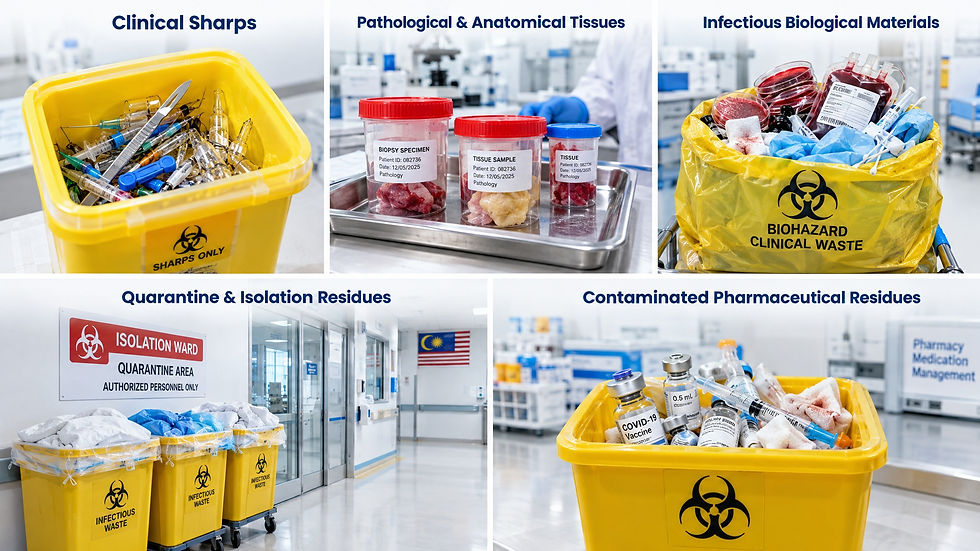
Clinical Sharps: Used hypodermic needles, intravenous cannula sets, scalpels, lancets, suture blades, broken culture tubes, and contaminated glass ampoules capable of causing punctures or cuts.
Pathological and Anatomical Tissues: Human organs, body tissues, amputated limbs, placentas, biopsy specimens, and body fluids collected during operative or forensic procedures.
Infectious Biological Materials: Disposable culture plates, diagnostic swabs, cotton dressings, blood transfusion bags, heavily soiled bandages, and disposable personal protective equipment (PPE) exposed to infectious pathogens.
Quarantined and Isolation Residues: Bedding, disposable materials, and research consumables originating from quarantined epidemiological wards or veterinary quarantine facilities.
Contaminated Pharmaceutical and Cytotoxic Residues: Discarded biological items, spent vaccine vials, and swabs tainted with trace medications (while bulk expired pharmaceuticals are managed under code SW403, contaminated delivery apparatus frequently intersects with SW404).
Differentiating SW404 from non-hazardous municipal waste is our primary legal and moral obligation. Placing even a single blood-soaked swab or used needle into general black waste sacks violates federal environmental law and compromises our municipal waste infrastructure.
Segregation, Packaging, and Biohazard Labelling: Our Step-by-Step Compliance Checklist
Compliance begins directly at the source. Once clinical waste is mixed with general municipal waste, the entire volume must be treated as biohazardous material, driving up operational costs and safety liabilities. Through standardised operating procedures, we can maintain seamless segregation from the ward to the treatment plant:

Colour-Coded Yellow Biohazard Bags: All non-sharp pathological, infectious, and tissue wastes must be deposited directly into heavy-duty, leak-proof yellow polyethylene sacks. Under national healthcare guidelines, these bags must feature a minimum thickness of 100 microns (0.1 mm) to resist puncturing or bursting under mechanical load. Each bag must be emblazoned with the internationally recognised black biohazard trefoil emblem.
Rigid, Puncture-Proof Sharps Bins: Sharps present the greatest physical transmission risk for blood-borne viruses, including Hepatitis B, Hepatitis C, and HIV. Sharps must always be placed into dedicated, rigid, puncture-resistant containers meeting MS 2535 or BS EN ISO 23907 standards. These containers feature a one-way aperture to prevent needle spillage. We must enforce the golden safety rule: seal and replace sharps bins immediately once they reach the three-quarters (75%) fill line. Overfilling or forcing sharps into bins is strictly forbidden.
Standardised Biohazard Labelling: Before moving containers to on-site storage, each bag and bin must bear a durable, weatherproof label measuring at least 10 cm x 10 cm, positioned conspicuously. According to DOE mandates, the label must state the scheduled waste code (SW404), the generator's registered name, address, telephone number, and the exact date waste generation commenced. Hand-scrawled paper stickers that fade in tropical humidity represent an instant audit non-compliance.
Consignment Notes and eSWIS Integration: Waste transfers from healthcare facilities cannot occur via informal commercial arrangements. All clinical waste generators in Malaysia must maintain an active profile on the Electronic Scheduled Waste Information System (eSWIS) managed by the DOE. Prior to waste collection, an eSWIS consignment note must be filed electronically, confirming inventory volume, transporter registration, and designated disposal facility details. This establishes an unbroken digital chain of custody.
Storage Timelines and Cold-Room Mandates: Navigating the 180-Day Rule and <4°C Preservation
A frequent area of confusion among hospital safety committees involves storage duration. Under Regulation 9 of the DOE scheduled waste regulations 2005, scheduled waste generators are permitted to store waste on-site for up to 180 days or up to a cumulative weight of 20 metric tonnes, whichever threshold occurs first.
However, clinical waste operates under a much stricter operational reality. Because biological tissues, fluids, and microbiological media decompose rapidly in Malaysia's humid, tropical climate, holding SW404 at ambient temperatures produces bio-aerosols, foul odours, toxic gases, and pest vectors within hours.

To prevent biological decomposition, official Department of Environment guidelines dictate that any clinical waste stored on-site for longer than 24 hours must be housed within a dedicated cold room clinical waste storage facility maintained constantly below 4°C (typically between 0°C and 4°C).
To satisfy DOE and Ministry of Health compliance audits, our on-site clinical waste storage facilities must incorporate:
A dedicated, lockable cold-room unit restricted to authorised, trained waste handlers.
Calibrated temperature monitoring sensors with external digital displays and continuous historical logging.
Seamless, non-porous floorings, bunded perimeter containment curbs, and dedicated internal drainage routed to an approved effluent neutralisation sump.
Uninterrupted secondary power supplies (backup diesel generators) to prevent thermal degradation during municipal power outages.
Prominently mounted emergency spill kits, emergency eyewash stations, and comprehensive personal protective equipment (PPE).
Environmental Quality (Amendment) Act 2024: Escalated Fines Up to RM10 Million
The regulatory environment across Malaysia has shifted toward zero-tolerance enforcement against hazardous waste negligence. With the gazetting and enforcement of the Environmental Quality (Amendment) Act 2024, our legislative framework now carries unprecedented penalties for scheduled waste contraventions.

Under the amended statutory provisions, improper handling, illegal stockpiling, unauthorised storage, or unlicensed dumping of scheduled waste such as SW404 exposes institutions and responsible executives to:
Mandatory maximum fines reaching up to RM10,000,000 (ten million ringgit).
Mandatory custodial prison terms of up to 5 years for culpable corporate officers, directors, and safety managers.
Immediate site shut-down orders issued by the Director-General of Environmental Quality.
Routine inspections conducted by state DOE enforcement officers thoroughly review our internal manifests, eSWIS balances, cold-storage logbooks, and disposal verification receipts. Ensuring compliance with clinical waste management Malaysia is no longer merely an administrative chore; it is an existential corporate governance priority.
High-Temperature Incineration: Why Alternative Methods Fall Short for SW404
In the broader waste management sector, alternative thermal and physical methods such as autoclaving, microwave irradiation, or chemical disinfection are often discussed. However, when evaluating the complex matrix of SW404 clinical waste, the Department of Environment establishes high-temperature incineration Malaysia as the definitive treatment benchmark.

Autoclaving and microwave systems apply steam heat to destroy vegetative pathogens, but they cannot achieve the complete chemical breakdown required for anatomical tissues, quarantined biological matter, or cytotoxic residues. Moreover, autoclaved waste retains its physical form, meaning plastic syringes and anatomical specimens remain intact. Discarding untreated or partially treated clinical waste into municipal landfills is strictly prohibited under Malaysian law.
High-temperature thermal destruction fundamentally alters the hazardous nature of SW404 by converting biological pathogens, complex chemical structures, and plastic matrices into sterile, inert mineral ash and clean flue gases:
Primary Combustion Chamber (850°C to 1,000°C): Clinical waste containers enter a controlled, oxygen-managed primary furnace chamber where complete thermal degradation, gasification, and combustion of solid organic matter occur. Pathogens, bacteria, and viruses are eradicated instantly.
Secondary Combustion Chamber (≥1,100°C): Volatile gases and combusted organic fractions transfer into a secondary re-combustion chamber operating at temperatures exceeding 1,100°C, with a minimum gas residence time of 2.0 seconds. This sustained thermal envelope breaks down complex aromatic hydrocarbons, volatile organic compounds (VOCs), and precursors to polychlorinated dibenzo-p-dioxins and dibenzofurans (PCDD/Fs).
Flue-Gas Cleaning and CEMS: JNA’s Advanced Thermal Treatment Process
At J&T Naza Alam Murni (JNA), our advanced Sustainable Scheduled Waste Treatment Centre (SSWTC) located in Bukit Tagar, Hulu Selangor, operates an advanced Scheduled Waste-to-Energy (SWTE) thermal treatment facility designed specifically to resolve complex hazardous waste challenges.
Thermal destruction requires equal vigilance toward atmospheric emissions. Our facility integrates an advanced, multi-tier Air Pollution Control System (APCS) that rigorously scrubs combustion flue gases prior to atmospheric release:

Selective Non-Catalytic Reduction (SNCR): Reagent injection within the high-temperature zone converts harmful nitrogen oxides ($NO_x$) into harmless nitrogen gas ($N_2$) and water vapour.
Semi-Dry Acid Gas Scrubbing: Atomised lime slurries neutralise acidic combustion gases, such as sulphur dioxide ($SO_2$) and hydrogen chloride ($HCl$).
Activated Carbon Injection: High-surface-area activated carbon is injected directly into the flue stream to capture trace heavy metals, vaporised mercury, and residual dioxin molecules through powerful physical adsorption.
High-Efficiency Baghouse Fabric Filters: Sub-micron particulates and spent scrubbing sorbents are captured through dense needle-felt membrane filter bags, preventing fine particulate matter ($PM_{10}$ and $PM_{2.5}$) from entering our atmosphere.
Continuous Emission Monitoring Systems (CEMS): Our stack emissions are continuously evaluated by automated optical and chemical telemetry systems. CEMS transposes live data directly to the Department of Environment's central monitoring network 24 hours a day, ensuring absolute adherence to the Environmental Quality (Clean Air) Regulations 2014.
Safe Slag Solidification and Final Disposal at Bukit Tagar
Thermal treatment leaves two solid by-products: bottom ash (vitrified slag) from the primary chamber and fly ash captured by our baghouse filtration systems. In our commitment to cradle-to-grave stewardship, waste handling does not stop at the furnace gate.
Bottom slag is sampled, analysed, and stabilised, while hazardous fly ash containing concentrated heavy metals undergoes chemical treatment at JNA's on-site solidification facility. Through precise chemical binder and cementitious encapsulation, heavy metals are permanently immobilised against leaching.
Following solidification, the stabilised monoliths undergo rigorous Toxicity Characteristic Leaching Procedure (TCLP) testing. Once certified non-leachable, materials are placed into JNA's dedicated, DOE-licensed secured landfill cell. Engineered with multi-layer high-density polyethylene (HDPE) geomembrane liners, leak-detection geotextiles, and specialised leachate collection infrastructure, our secured landfill guarantees that our surrounding groundwater and soil remain completely protected for generations.
Partner With JNA: Streamline Compliance With Our Licensed SWTE Collection Programme
Maintaining compliance across every facet of SW404 clinical waste disposal Malaysia requires technical precision, capital investment, and regulatory transparency. Hospital procurement boards, laboratory managers, and environmental safety officers bear immense responsibility under Malaysia's modernised environmental protection laws.
We do not have to shoulder these operational burdens alone. By partnering with J&T Naza Alam Murni scheduled waste services, healthcare institutions gain immediate access to:
A nationwide fleet of DOE-licensed, temperature-controlled transport vehicles equipped with GPS tracking and spill-containment safety equipment.
Seamless eSWIS consignment note coordination, transparent digital documentation, and rapid issuance of certificates of destruction.
Guaranteed ultimate treatment at our cutting-edge Scheduled Waste-to-Energy thermal treatment centre in Bukit Tagar.
Complete freedom from long-term legal and environmental liabilities under the Environmental Quality (Amendment) Act 2024.
Let us elevate our clinical waste management standards and safeguard our community. Discover our integrated scheduled waste incineration collection programme today. Explore our full suite of hazardous waste management capabilities by visiting our dedicated JNA service portal and connect directly with our scheduled waste advisory team.

Comments