

Industrial Waste-to-Energy (SWTE) in Malaysia: How High-Temperature Thermal Incineration Eliminates Hazardous Waste

At J&T Naza Alam Murni (JNA), our commitment to sustainable environmental management drives us to explore advanced solutions for hazardous materials. When managing industrial by-products, a dedicated waste to energy plant malaysia plays an indispensable role. The shift towards sustainable waste management has led to the rise of the SWTE facility malaysia model, transforming hazardous materials into usable power. Through modern engineering, a state-of-the-art industrial incinerator johor can safely eliminate harmful substances whilst supporting the national energy grid.
The Mechanics of High-Temperature Thermal Incineration and Recovery

Understanding how a scheduled waste to energy malaysia facility operates requires a close look at its core technology. The process begins in a high-temperature rotary kiln-stoker, designed specifically to process robust volumes of complex and varied materials. Within this heavy-duty rotating cylinder, temperatures exceed 1,000°C. This immense heat vaporises and oxidizes organic compounds, completely breaking down complex chemical structures and leaving behind inert slag or ash.
Following this initial stage, the gases proceed to a secondary combustion chamber. The residual heat from the flue gases then passes through a heat recovery steam generator (HRSG). This thermal recovery process converts water into high-pressure steam, which drives turbines to generate electricity. By integrating these systems, we effectively turn problematic waste streams into a valuable energy resource for the circular economy.
Scheduled Waste Codes Requiring Thermal Destruction
Not all hazardous materials are suitable for secure landfilling. The Department of Environment (DOE) regulates these materials through strict guidelines, mandating thermal treatment scheduled waste DOE protocols for categories with high toxicity, flammability, or infectious traits.
For instance, clinical and pathogenic wastes (classified under code SW 404), spent organic solvents, and specific pharmaceutical wastes cannot simply be buried. Their chemical volatility poses severe risks to groundwater and soil integrity. By subjecting these specific scheduled waste codes to thermal destruction, their hazardous characteristics are completely neutralised, leaving only stable, inert residues that are safe for final disposal.
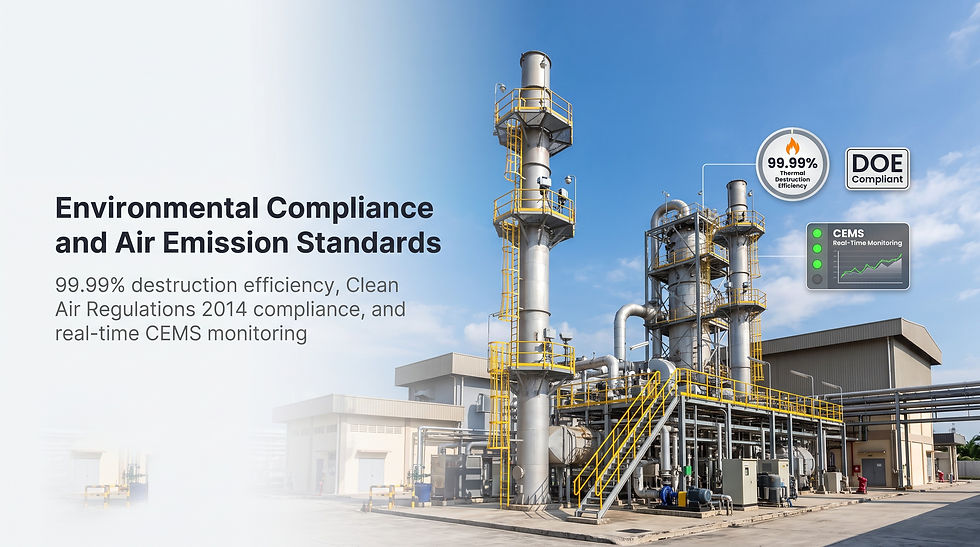
Environmental Compliance and Air Emission Standards
Operating an advanced thermal treatment plant requires absolute adherence to rigorous environmental standards. Working alongside an effective flue gas-cleaning system, our integrated combustion chambers guarantee a thermal destruction efficiency of 99.99%. To safeguard public health and air quality, the facility complies with the Environmental Quality (Clean Air) Regulations 2014, utilising Continuous Emission Monitoring Systems (CEMS) to provide real-time stack emission data to the DOE.
Stringent dioxin and furan controls are also mandatory. Because the combustion of chlorinated organic wastes can produce these persistent organic pollutants, the secondary combustion chamber operates above 1,100°C with a residence time of at least two seconds. Furthermore, advanced flue gas cleaning systems—incorporating baghouse filters, dry scrubbers, and activated carbon injection—ensure the plant operates well below strict DOE air emission limits. Through these rigorous measures, every stage of the process remains safe, clean, and entirely compliant.


Comments